
By Liakat Hossain
lhossain.com
Introduction
AI is booming. Billions in funding, thousands of new startups, endless hype on Product Hunt
and LinkedIn.
But behind that shiny layer, there’s a brutal truth:
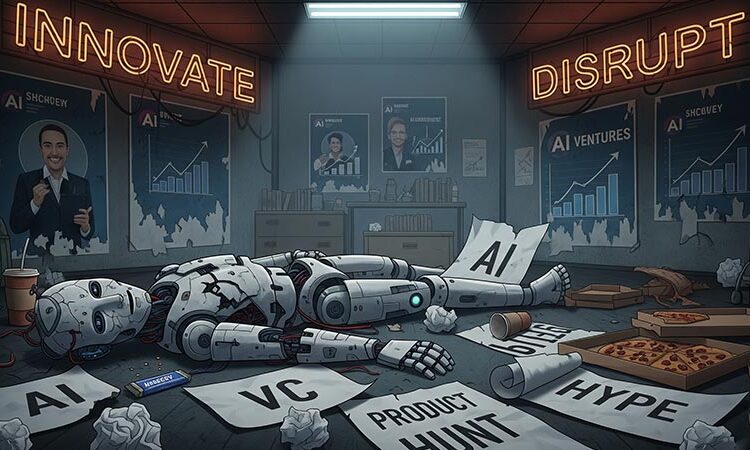
> Most AI startups die early — not because the tech is bad, but because the execution is
blind.
Since 2023, we’ve seen a gold rush of AI-powered products. Some launched in a weekend.
Others raised millions before writing real code. But in 2025, reality is catching up. Building
an AI tool is easier than ever — building a sustainable business is harder than ever.
This post is for every founder, builder, or investor who wants to understand why most AI
startups fail — and how to avoid that fate.
I. The Illusion of Easy Wins
The rise of tools like GPT-4, Claude, and open-source LLMs has made it feel effortless to
launch an AI product. A few prompts, some frontend polish, and you’ve got a demo. But
that’s all it is — a demo.
Founders confuse a working prototype with a real business. But in the AI space, the illusion
is stronger:
- Smart UI = real value
- Fancy output = defensible moat
- Viral tweet = product-market fit
Spoiler: none of that is true.
II. 7 Brutal Reasons AI Startups Die Fast
- Shiny Tool, No Problem Solved
Many AI tools are built because they’re possible — not because they’re useful. A chatbot for
everything. A text-to-X generator that nobody asked for. Startups forget: users pay to solve
problems, not to play with tech. - Built on APIs They Don’t Control
Relying 100% on OpenAI, Anthropic, or Hugging Face is dangerous. If pricing changes,
models break, or policies shift, your core product dies overnight. - No Real Data Advantage
AI startups need some defensibility — and that usually comes from proprietary data. If your
product trains on public sources or API responses only, you have no edge. - ‘Smart’ Team, But No Business Muscle
AI PhDs, ML engineers, and prompt wizards build great things. But too many teams forget to
bring in operators, marketers, and business-minded co-founders. - Zero Distribution Strategy
You built it. They didn’t come. Why? Because distribution is not built-in. No GTM plan, no
content engine, no outbound, no community — no users. - Legal + Trust Risks Ignored
AI products that summarize PDFs, generate emails, or process user data often skip legal,
privacy, or IP checks. This catches up fast — especially in B2B or regulated spaces. - No Exit Path — Not VC-Backable, Not Acquirable
Some AI startups can’t scale and can’t sell. VCs won’t back another GPT wrapper.
Enterprises won’t acquire non-strategic clones. Without direction, even good tech gets
abandoned.
III. What to Do Differently in 2025
- Build with users, not just APIs. Talk to your market before launching.
- Own something: the data, the niche, the distribution — not just the interface.
- Decide early: is this a tool, a product, or a real business?
- Validate pricing early. Monetize small, iterate fast.
- Partner where needed — AI alone isn’t the full story.
Final Thoughts
AI is a powerful engine — but it’s not the destination.
Your job as a founder is not just to build something smart, but something that lasts. In 2025,
success comes from execution, distribution, and focus. If you’re chasing hype, you’ll burn
out. If you’re solving real problems with sustainable systems — AI becomes your
superpower.
Most AI startups die early. But yours doesn’t have to.
This article is based on an original concept and early draft by Liakat Hossain. Edited and structured with the help of AI tools to improve clarity and narrative flow.